

article and image by Lisa R. Lowry, MD
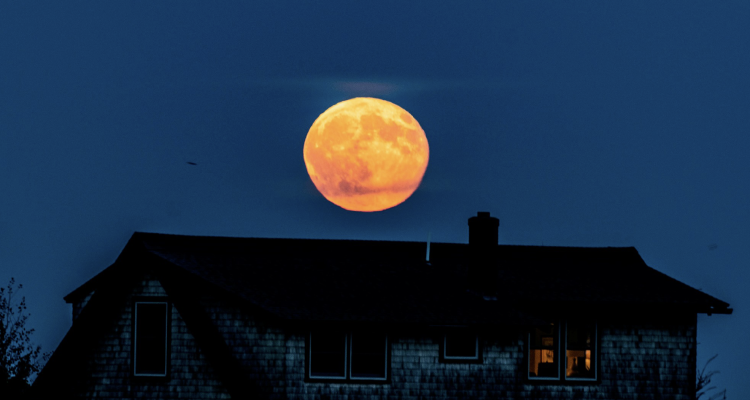
The golden hour, that magic time just before sunset, had poured its sweet mixture of honey-colored hues all over the rocks lining the beach in Kennebunkport, Maine. With the moonrise time, phase, and direction provided by timeanddate.com, my companions and I were anticipating a brilliant full moon to appear on the eastern horizon. We had identified a location ideal for viewing, although its proximity to a former President’s compound gave me second thoughts about aiming a large telephoto lens in that direction. With camera gear in hand, I picked my way over granite giants, carefully aware of how slick the smallest amount of water made them. A quick check of the compass confirmed we were in fact pointed in the direction of the azimuth, the path the moon would take. Being directionally challenged from birth (breech), I found comfort in identifying the large body of water known as the Atlantic Ocean as my eastern boundary.
Having spent considerable time in a career (Medicine) that demanded preparedness, my camera was already set on optimum settings, the batteries and gear checked. As a novice photographer, I came with no expectations of obtaining anything recognizable. As the Golden Hour dipped into the Blue Hour, there was nothing left to do but wait for lights, camera, and action!
The quiet that surrounds the ending of the light wrapped us in dusky blueness, the ocean waves hushing the sounds of the day. We sat in solitude, waiting like Linus, for the Great Pumpkin to appear. At first, the tiniest halo pierced the pressing blue, leaving room for wonder if this was, in fact, the main attraction or man-made distraction. As the orange slice pushed further into the night, it left no question. This Harvest Moon was in full glory. As it crept higher and higher into the sky, tires pressed suddenly against pavement, and gravel gave way to a multitude of slamming car doors and people rushing onto the beach, phones in hand and expressions of awe falling from mouths. Solitude gave way to a flash mob, as camera phones waved in the air. Chaos had also entered my own carefully crafted Universe, as the gear I had so thoughtfully prepared malfunctioned (operator error), and I rushed to salvage my photographic disaster. It gave me time to pause and enjoy this wondrous site, despite whatever mechanical/personal failure I was experiencing.
The moon rose higher, throwing off the orange-red reflections of a sun now vanished, painting itself instead with a cool, pale blue. The crowd dispersed, filing out like concertgoers after the last encore.
I thought about the plight of the moon, as it rose, lonely in the sky, abandoned by its fickle fans once it was done magnifying the effects of the sun. How harshly it was referred to “in phases.” Just a “sliver” or a “quarter” … “waxing” or “waning.” Not to mention its “dark side.”
It reminded me of one of the themes for this issue, retirement. Having retired from my medical practice just shy of a year ago, the question of what happens when the big show is over is not unlike the dilemma of the moon. What now? Time to fade away or start again?
Not being a sociologist or a financial/wealth planner, my contribution to this topic by design falls within the health domain. So, what I should do is give you the rundown on the things that can prepare you to wax well into your next phase of glory. It goes something like this:
“Get your vision checked. Glaucoma and cataract treatments give a good return on investment. Better vision means more independence and a reduced fall risk. Check your hearing. Loss of hearing has a significant impact on your life. It is socially isolating, challenges even the best of relationships, and robs you of joy. Any signs of obstructive sleep apnea? Sleep apnea is real and affects not just you, but your significant other and those who are around you daily. The health of your teeth, gums, and microbiome (all the little organisms that live in your mouth) play a significant role in nutrition and metabolism. See your dentist and keep it clean. Are you up to date on all the recommended cancer screenings and vaccinations? Are you doing breast exams when applicable? Take stock of your personal and family history of cancer and have an honest discussion with your provider about what screening is right for you. Shingles, pneumonia, and RSV are unpleasant at best, and vaccinations are available to lessen your risk. Be aware of your personal and family heart and stroke history and work with your provider to get proper evaluation, testing, and management. Report signs/symptoms of changes in cognitive abilities, speech, movement, or sensation sooner rather than later. Pay attention to your digestive functioning and report changes early. The gut microbiome is a real thing. Treat it with respect. Speak up if you are having urinary symptoms, sexual dysfunction, or repeated infections. There is much more available now in terms of help. By this point, something is bound to hurt, even just occasionally. Knees, backs, necks, and bone loss. When you are in pain, thinking clearly is challenging. Get a good team together. If you have growths on your skin, get them checked. Let them check everywhere.
Be responsible for your personal hygiene. I don’t mean brushing teeth and bathing, although those are good ideas. I mean, take responsibility for your diet, exercise, mental health, and habits.
But all this information is readily available everywhere. What I really want to say is…
By this time in life, most of us have known many things. We have experienced love, loss, grief, anger, betrayal, frustration, shame, joy, boredom, fear, anguish, sadness, guilt, and humility. We have both seized and missed opportunities. We have been treated both fairly and unfairly. We have been the victims of circumstance, and the reason for circumstances being what they are. And we are still here (at least if you’re reading this). How we choose to use all this learning, all this information, all these experiences are for me the real questions that retirement asks.
As I see it, we are stepping into a “phase” of our life more fully equipped than when we arrived here. Our bag of tricks may not include the most accurate eyesight, but our vision may be spot on if we have chosen to allow the long list of life’s experiments on us to leave us open to new adventure and learning rather than fearful and dispassionate. As a physician, I have had the rare opportunity to participate in the lives of all sorts of people. I have taken notes along the way, learning from those who have moved into their “golden” years with grace, joy, and a mischievous grin. These are the common traits I have picked up on:
• They have cleaned out their closets. Yes, usually in a physical sense, but really, I mean, they have looked at their lives with honesty, owned their mistakes, and done their best to make amends. They have asked for and granted forgiveness when needed, and if that was not available, worked at making themselves better for future endeavors.
• They make time for PEACE. Call it slowing down, smelling the roses, whatever. It’s a real thing. They find a way to quiet everything down and appreciate the beauty around them, in others, and in themselves. It is a mindset, a way of looking at the world. It is choosing to see the good.
• They get things done. Yes, it’s great sipping coffee and watching everyone else go off to work, but these people get SH-T done! Not for their own glory or admiration, most of them already have that in their back pocket. They find real joy in doing even the simplest things, often for others. This is the special sauce on which they thrive.
• They keep learning, and failure is of no consequence. They are not focused on being the best at whatever, but rather they delight in the journey of learning and challenging themselves, in doing their best. When others around them are better at the task, they offer praise and admiration, delighting in the joy and satisfaction the other person has achieved.
• They thrive on connection. They send cards, letters, and check up on you. They talk to anyone, but especially strangers, those outside of their socioeconomic distinction, and anyone who seems lost.
• They value their friendships and families. They have honed their listening skills. They are not planning their magnanimous response while you are talking; they are gathering all the information to respond with understanding and intent. They tend not to use sentences that start with “When I was your age…” or “What you need to do is…”
• They are grateful.
I try each night to check out the moon, appreciating all its phases, including that rarest, when it eclipses the sun.