

by Scott Martinez
When we talk about the economy of Tyler and Smith County, the conversation often turns to healthcare, education, manufacturing, retail, and the tremendous growth our region continues to experience.
But what exactly do we mean when we talk about the agricultural economy?
For many of us, agriculture brings to mind farms, cattle, and crops. Drive down just about any country road in East Texas, and you’ll see all three. But the agricultural economy extends far beyond the farm. It includes the businesses and industries that move agricultural products from production to processing and ultimately to market. Together, they create a cycle of economic activity that supports jobs, drives investment, and improves lives right here in Tyler and Smith County. In fact, Tyler’s organized connection between business and agriculture goes back more than a century.
In 1906, the Tyler Commercial Club—the organization that would later become the Tyler Area Chamber of Commerce—worked with the U.S. Department of Agriculture to establish something groundbreaking. Smith County appointed William C. Stallings as an agricultural agent. He became the first county agricultural agent in Texas and the first in the nation assigned to serve a single county. That distinction is worth remembering. More than 120 years ago, Tyler’s business community recognized something that remains true today: agriculture and economic development go hand in hand.
Today, that relationship can be seen in some of the largest employers and capital investments in Smith County.
Let’s start with poultry.
Wayne-Sanderson Farms employs more than 2,000 people in Smith County and processes approximately 267,000 chickens every day at its local operations.
Those products don’t just stay in East Texas. They enter a national food-service supply chain that includes some of America’s most recognizable restaurant brands, including Chick-fil-A and Raising Cane’s. A product processed here in Smith County can ultimately end up on a restaurant table hundreds of miles away.
Soules Foods is another example, and one with deep roots in Tyler.
John Soules Foods, now Soules Foods, began in Tyler in 1975. What started as a local operation has grown into a major national food company and one of the country’s leading processors of fajita meat.
Its consumer products are now marketed under the Soules Kitchen name, but its roots remain firmly planted in Tyler. The company’s products have supplied restaurants around the country with national brands such as Chili’s, demonstrating how far a Tyler-based food-processing company can reach.
The economic value of agriculture doesn’t end when an animal leaves the farm, or a crop leaves the field. Its value grows as products are processed, packaged, marketed, and distributed, meaning more jobs and a larger investment.
Many of us drink milk every day, and if you shop at any of the local Brookshire Grocery Co. stores, you will see another familiar brand on the shelves, Hiland Dairy.
Hiland Dairy has made an investment of more than $100 million in its operation near Erwin Street, dramatically expanding and modernizing a facility that has long been part of the Tyler community.
The expansion added state-of-the-art processing, filling, storage, laboratory and automated packaging capabilities and gives the Tyler operation the ability to process more than one million gallons of milk per week. That’s enough milk to provide more than 2.2 million people with a glass every day for a week.
Timber and forest products are another longstanding part of East Texas agriculture.
Great Southern Wood Preserving, known nationally for its YellaWood brand, has built the largest wood-treatment facility in the world in Smith County. The facility can treat more than five million board feet of lumber every week.That lumber moves from East Texas into the construction supply chain, helping build homes and other projects across a much larger market. It represents the evolution of one of our oldest industries—timber—into sophisticated modern manufacturing and distribution.
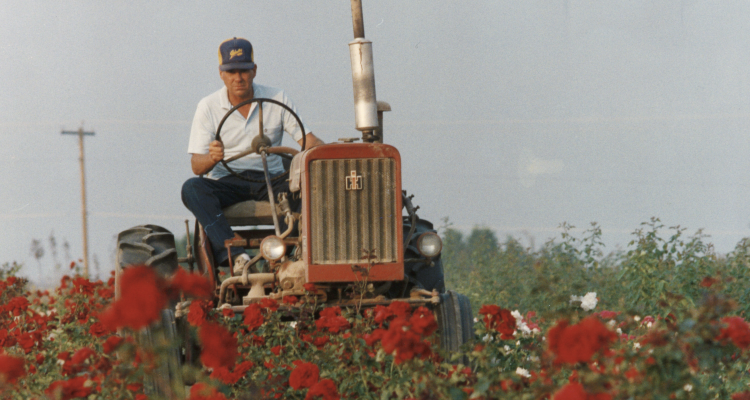
Of course, agriculture has also shaped Tyler’s identity through the industry for which our community is perhaps best known: roses.
Tyler’s rose industry grew from the agricultural economy that defined Smith County in the early 20th century. By the 1940s, more than half of America’s rose bushes were reportedly being grown within ten miles of Tyler.
Much of today’s activity involves processing, storage, distribution, and the broader nursery industry rather than fields filled with roses, but its legacy is unmistakable.
The Tyler Rose Garden, the Texas Rose Festival and our identity as the Rose Capital of America all trace their roots to agriculture. What began as an agricultural industry became part of Tyler’s identity and ultimately part of our brand around the world.
We spend a great deal of time thinking about the industries we should recruit next, and that work is necessary. But some of our best opportunities for economic growth also come from recognizing the competitive advantages we already have and finding ways to build upon them.
Smith County has those advantages in agriculture.
For economic development, that’s an important reminder. Growth isn’t only about recruiting the next company to Smith County. It’s also about recognizing the industries that are already successful here and finding ways to help them invest, expand, and create more opportunities.
Agriculture looks very different in Smith County today than it did when local business leaders helped establish that first county agricultural agent in 1906. The technology has changed, the companies have grown, and the scale of investment is dramatically different.
What hasn’t changed is agriculture’s importance to our economy.
It helped build Smith County, and it continues to create jobs, attract investment and connect our community to markets across the country. That’s a story worth telling—and an economic advantage worth building on.