

by Paul Swen
The sun had not fully crested the horizon as the team slowly approached. They could see where the accident happened. The wound was obvious with blood seeping from the sizeable gash. The enraged combatant stood close by, defiant, ready to challenge anyone to the next fight. It was a dangerous situation, to say the least. “We can’t go in there without risking more turmoil,” Dr. Taylor J. Willis spoke quietly to the team. “Load up the gun, and we’ll take care of this from a safe distance.” A dart was carefully loaded with medication, and Zola got a shot in her shoulder to ease the pain. “Wildebeests are tough. They’re native to Africa. They are built to survive in harsh conditions while escaping attacks from lions and hyenas. There was no way she would have taken oral meds. Thankfully, the wound is clean and she should heal up just fine. We’ll keep an eye on her and monitor the situation throughout the rest of the day to be safe. Now, let’s get back to the hospital.” And thus begins a rather ordinary day for the medical team.
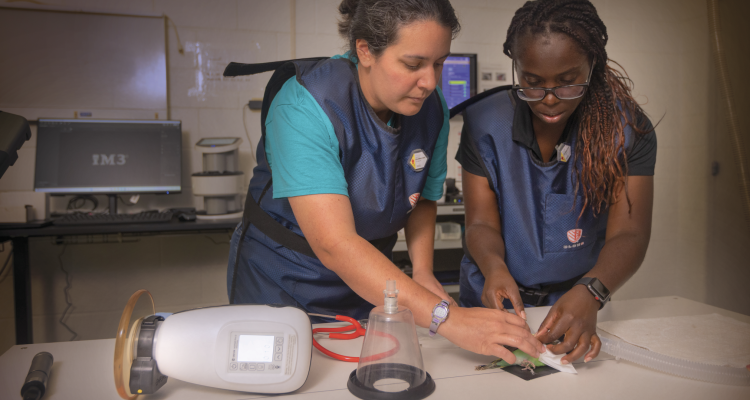
As the veterinary staff entered the hospital, Stefanie Santee, licensed veterinary technician, issued directions. “We need to move quickly. We need X-rays ASAP, and considering the situation, the patient will need to be sedated.” With those instructions, a flurry of activity was launched with precision and grace. The anesthesia equipment was wheeled into place. X-rays were pre-labeled with patient information. Charts were initiated. When everything was set, Hannah McCurrin, vet tech, went to gather the patient, a tiny parakeet, weighing less than two ounces. They needed to get clear images of her injured wing and her coelom for egg monitoring. Since there was no way for a bird to lie still for the imaging, anesthesia would be needed, and considering the tiny size of the patient, the amount of anesthesia administered had to be perfect. With cool, professional calm, the team progressed through the procedure flawlessly. Eric, a veterinary intern, monitored the gas, Dr. Willis positioned the patient in place, Stefanie conducted the X-rays, and Hannah fulfilled the charting with all the pertinent information. Crisp black and white images appeared on the monitor for the doctor to review. “Good. No broken bones. No signs of egg coelomitis. It looks like she’s going to be just fine. Now, let’s wake her up, get her comfortable.” The process took mere minutes, and the tiny bird was revived and placed back in the safe ICU recovery area. With the procedure complete, the team began to prep the surgical suite for the next case. So far, so good. The team had taken care of a 300-pound, dangerously horned antelope and a tiny Australian parakeet, all before lunch.
“We have to be ready for just about anything,” explained Dr. Taylor Willis. “There are thousands of animals here at Caldwell Zoo, and we are responsible for the care of every one of them.” And they come in every shape and size. Imagine a clinic that doesn’t simply take care of young and old, male and female patients. This clientele ranges from tiny, delicate birds to 10,000-pound elephants. Animals that are warm-blooded and cold-blooded, aquatic and desert-dwelling, feathered, finned, furry, scaled, and shelled. A vast and diverse menagerie of life is under the dedicated care of a small but efficient medical team. To make matters even more complicated, the patients can’t ever just tell you what’s wrong. Plus, many of them are very shy or downright afraid of humans. So, it takes an incredible depth of understanding to care for the wide variety of residents that live at the zoo.
“There’s really never a dull day here and no two days are the same,” explains Stefanie Santee. “We deal with widely different types of anatomy. One day, we may need to check on a little chameleon that isn’t behaving quite normally, and then we may need to treat a claw of an African lion. It’s challenging for sure. But that’s part of what makes it rewarding. You don’t get into this field if you want consistency. It’s never the same old thing.” All of this variation keeps the vet staff rather busy. “It’s a serious team effort,” continues Santee. “The vet staff has the medical knowledge, but we rely heavily on the animal keepers as well.” The keepers interact with the animals every day. They feed them and keep their habitats in good shape. Keepers know the normal behaviors for the different animals. Part of their job is to be observant and share information if anything seems out of the norm. That information is passed to the vet staff, and a treatment plan can be administered.
“The zoologists in the animal departments are absolutely essential for providing good care,” shares Dr. Willis. “They know how the animals behave. They know their personalities. So, the keepers can spot something out of the ordinary. Then we can work with them to treat whatever issue arises.” For instance, Ricki Roemer, a supervisor for mammals, noticed that Nijeri, the female lion, was paying more attention than usual to one of her paws. Ricki took a closer look and got a photo of the paw in question, and showed it to the doctor. They agreed that the dewclaw had grown a bit too long and would require trimming. Therefore, in the next few days, the keepers and vet staff will make a step-by-step plan to safely sedate the lion so they can trim the errant claw and get the lion back to her usual prowling in her spacious African savanna habitat. “We depend on the keepers,” continues Dr. Willis. “First of all, we can’t be everywhere, all the time. We need our teammates to have eyes on all the animals throughout the park. Then, as you can imagine, we’ll need their help to actually complete the procedures. A fully mature African lion weighs hundreds of pounds. We’ll need help throughout the entirety of the procedure.”
This brings up another important point. How do you administer medical care to animals that weigh hundreds or even thousands of pounds? You can’t ask them to make an appointment and show up at the hospital. “We pretty much take the hospital to them,” explains Alexis Jones another one of the expert veterinary technicians. “For many of the species we work with, it’s simply not possible to bring them inside our clinic. So, we need to be able to treat them in their habitats.” That means the team loads up portable ultrasound machines, X-ray equipment, along with cases and cases of medicines, and treatment materials to take to whatever location is needed. Every week, the schedule is filled with treatments and procedures that are throughout the zoo.
“The best care is preventative care,” shares Dr. Willis. “Our first goal is to keep all the animals as fit and healthy as possible. We put a lot of focus on regular and routine check-ups.” So, exactly how does one give a check-up to a tree-loving howler monkey or a 4,000-pound rhinoceros? “Again, we work with their keepers,” explains the doctor. “Our teams participate in a great deal of voluntary engagement with the animals. The training builds trust with the animals and allows us to perform important medical procedures without having to sedate them. The animals follow the prompts or cues from the keepers, and we’re able to do the work we need to do all voluntarily.” For instance, Kiano, the resident black rhino, is getting up there in years and suffers from Iron Overload Disorder, which is common for the species. Blood draws allow the vet team to make sure he’s in good shape and not fighting any unforeseen infections or diseases. After months of training, Kiano has no problem getting some of his favorite treats while the team performs a blood draw on one of his front legs. With that done, Dr. Willis and the rest of the vet staff can return to the hospital, where they can examine the samples under the microscope in the clean and air-conditioned confines of the exam room.
Until the next exam. And no matter what the situation, whether a turtle needs a tune-up or a duck needs help with an injured wing, they’ll be ready to go.