

by Allen Morris
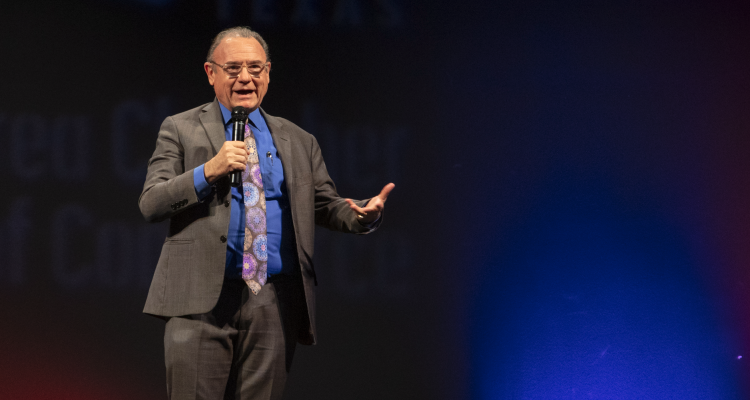
Lindale native, Dr. Ray Perryman, has been presenting his Annual Economic Conference across Texas for 42 years. This year marks the 37th time he has come to Tyler to share his insights. For the second year in a row, the conference in Tyler was held at the W.T. Brookshire Conference Center, located adjacent to Tyler’s famous Rose Garden. At a news conference held just prior to his presentation on January 15th, Dr. Perryman stated that he had both good news and bad news to report. The good news is that, despite the pressures based on the current international turmoil across the globe, the East Texas economy is performing well, with growth in several industry groups and unemployment trending below both state and national rates. The bad news is that the short-term outlook for East Texas is a slowdown in growth rate, based on reactions to global economic factors that include tariffs, current turmoil taking place in the Middle East, and the saber-rattling taking place in the Far East.
“That cold fact is, regardless of the overall positive economic condition in Texas (and Tyler in particular), what happens in other parts of the world directly affects East Texas.” Perryman states emphatically, “Shutting down the border and implementing more control on immigration has impacted Texas more than any other state. The reason is simple: the Texas agricultural economy is reliant on immigrant workers.” And while acknowledging the contribution of immigrant workers to Texas’ economic health, Perryman is convinced that we need immigration reform. “The system has been broken for many years, and it needs to be addressed in order to create a long-term solution. There are construction projects in Texas that have stopped because there are not enough workers available to fill the need.”
“2025 was a difficult year,” Perryman says, “and throughout the nation in the recent years, we have seen job losses in virtually every market sector.” The Perryman Group’s research indicates that nationwide, there were 1.5 million fewer workers in 2025 than in the year before. Of the total number of people working, undocumented workers, some 1.2 million individuals, comprise 9% of the total workforce. “50% of agricultural jobs and 40% of construction workers are filled by what we refer to as undocumented workers,” Perryman reports.
Another example Perryman cites is how the tariffs on imports are affecting consumers in Texas. “Texas is the largest exporter of any state in the Union, by a wide margin. That makes Texas more vulnerable to the uncertainty created by retaliatory tariffs, while also dealing with the impact of more stringent immigration policies,” Perryman says. Currently, tariffs add 30% to the cost of imported goods. “By April, it will rise to around 75%,” Perryman predicts, “Rising costs are passed on to the consumer, which drives inflation. And a big problem is the psychological impact on the minds of consumers.”
To illustrate his point, Perryman points to the housing market. “Right now, we have a severe shortage of affordable housing. Mortgage rates have fallen recently, but people aren’t buying. Many would-be buyers have adopted a ‘wait and see’ attitude, which is based on fears about what the future holds.”
But all is not doom and gloom. According to Perryman, “East Texas has managed to fare better than other areas of the country, due largely to the diversification of its economic base.” The greatest growth area in East Texas remains in biosciences and health care. He predicts the medical field will grow by more than 3,400 positions over the next five-year period. He also predicts the business and financial services field will generate another 1,610 positions. “However, I would like to point out that right now, 25% of the doctors moving into Tyler are immigrants. And in the field of engineering, 50% are immigrants. Another reason I believe immigration reform is necessary for our future to remain bright.”
“I am part of the Baby Boomer generation, which encompasses those of us who were born between 1946 and 1964. We have, for all of my life, been the most catered-to generation in history. Most of us grew up in a time of nonstop growth and prosperity. Incredible advances in technology took place in our lifetimes, from the creation of personal computers and landing a man on the moon, to the more recent developments in artificial intelligence technology. We have witnessed the greatest technological advancements in the history of mankind, over a relatively short period of time.”
To put that in perspective, think about the invention of the printing press, which enabled the spread of knowledge across the globe. Gutenberg invented the press with movable type in 1440. The next major advancement in technology took 386 years to be accomplished. That was the invention of photography, with the first photograph being made in 1826. The telephone was invented in 1876, but it was not common in homes until the 1920s, and then only 35% of the U.S. populace had one in their homes.
“Just as the invention of the printing press, photography, the telephone, and later personal computers were transformative technologies, today we have artificial intelligence. AI is the transformative technology of our age, and it’s almost completely misunderstood by most people today. But AI is the future, and it will have an impact as great, or possibly greater, than the personal computer has had,” says Perryman.
“Let me say that I believe there are challenges ahead, but Tyler and East Texas will continue to grow and prosper over the next five years,” Perryman predicts. The next couple of years are likely to have slower growth rates than in the past, but we will have steady growth ahead. The two most important factors facing East Texas are education and water conservation.
“I’ve said this before: Education is the single most important ingredient for a prosperous future. We must have an educated population, especially to ensure the young people who will be taking over tomorrow are ready to face the challenges ahead. And water is still the most important natural resource in the world. We need to use our water supply more efficiently, and we need to concentrate on developing technologies for reclaiming wastewater and desalination of water from both the oceans and from underground sources. We have been fortunate in East Texas to have abundant water supplies; however, we need to prepare for the future to ensure we have water in the years to come.”