

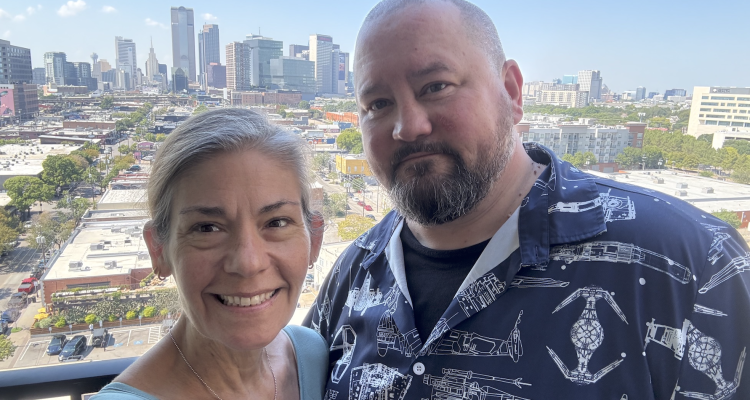
by Amy Brocato Ewen
Dear Loved Ones,
This is probably the most difficult – and the most important – letter I’ve written in my life.
There are no words to express how it feels to have received the most selfless, generous, gracious gift – one of your loved ones’ organs. Believe me, I’ve written professionally for most of my life and no thesaurus, no dictionary, no words in my vocabulary capture the enormity of the second chance at life I was given on August 21, 2025.
As we approach the year anniversary, I’ve grappled with how – and when – to reach out to you. This joyous celebration of mine also marks one of the darkest days for you. But I knew I wanted to reach out. I’ve known I have wanted to write to you since before this organ was mine; because I’d want to know about the legacy that someone I loved left. I pray you do, too. Thank you for receiving this letter and thank you for fulfilling their desire to be an organ donor.
I’d like you to get to know the rest of me, since you already know and love my liver. It’s an odd feeling not to know who I’m writing to – or writing about. All I know is that your loved one was in their early 30s, negative for all of the medical reasons that might be a stumbling block to transplant, and positive for Epstein Barr (as are 90-95 percent of the rest of the population) I know their blood type is A; mine is A+. That’s it. That’s all I know. I’ve thought a lot about your person – my person – and I spend every single day trying to be the best steward of their gift.
Blindsided
I went to sleep on the night of December 11, 2024, not feeling well. My husband and I had just gotten home from our church’s Christmas fellowship meal and I’d been looking forward to it. But when we got there, the only thing I could stomach was Vonda’s chicken and dumplings, and that was only a few spoonfuls. I started to feel like I was going to either pass out, or be sick, toward the end of the dinner, but Pastor Nipp was delivering a message and he was between my table and the restroom, so I stumbled outside thinking the cooler night air might make me feel better. It did not. I had to be sick and (I’m sorry if this is too much information, I just wanted to put it all out there) and couldn’t decide to be sick on the grass or use the county trash can. I picked the trash can. This is important. It was dark outside; I couldn’t see the contents of my stomach. While it wouldn’t have changed the outcome, I might have been able to get a jump on treatment had I seen the very distinctive characteristics of my vomit that night.
The next morning, I woke up still feeling puny, so I called out of work. I hadn’t felt 100 percent for a few weeks, my stomach hurt constantly, but I chalked it up to stress because between work, which meant hitting our end year fiscal goal, and the holiday season, I felt like I was burning the candle at both ends.
It was a Thursday. My husband, Brennon, left for work. I was still in bed. It couldn’t have been more than 30 minutes after he left; I was in the bathroom throwing up. But I wasn’t throwing up the previous night’s dinner. I was vomiting blood. So much blood. I smeared it on the sides of the toilet, on the floor, on the sink and vanity when I tried to clean up. I called Brennon and told him what had happened. He was in the car heading home immediately. In the meantime, I threw up again. It was also copious amounts of blood. Afterward, I learned the sign of a GI bleed is vomiting blood the consistency of coffee grounds and that’s exactly what it was. I’ll spare you the rest of the details, but let’s just say the whole GI tract was affected. I managed to somewhat clean up the bathroom and pull on leggings and a sweatshirt before he arrived, bundled me into the car, and sped to the closest emergency room to our house, which happened to be a satellite center for our main health system. I think I walked in, I can’t remember. I heard them say my blood pressure was 50/30, and I remember thinking that was way too low to still be conscious. I had blood drawn and was taken right back to CT. I think they did a CT and an ultrasound, and next thing I knew, they were talking about ambulance transfer to the main hospital campus. The ER doctor said, “Looks like end stage liver disease.” I was sure I heard him incorrectly.
In the ambulance, the EMT’s had to keep me stable. One medic asked me if I drank a lot. I said no, not registering the import of the question. We arrived at the ER at UT Health East Texas, but I got a bed quickly. Several doctors came in and out talking about things I wasn’t grasping in the moment. We were talking about a TIPS procedure. We were talking about a CARTO procedure. I couldn’t keep the faces of the doctors straight and I got so frustrated trying to remember who was telling me what. Ultimately, they decided I was not stable enough for a TIPS, so they went the CARTO route. CARTO is an acronym for “Coil Assisted Retrograde Transvenous Obliteration,” which is a whole lot of fancy words to say they threaded a catheter through my femoral artery and used a coil system to cauterize the varices (ballooning blood vessels) in my GI system that had burst from portal hypertension, another hallmark of liver disease. I was under anesthesia during this, but I think in the great scheme of things, it was a quick procedure and I woke up easily. That’s the first time I heard a doctor say the word “cirrhosis.” My mind went straight to, “That’s not possible; that’s not my lifestyle.” Little did I know.
Later, in ICU, the nurse who met me at bedside asked if I’d had anything to drink that morning. Well, no, I couldn’t keep anything down, so I hadn’t had anything to drink. That’s not what she was asking.
I had an EGD (scope of my upper GI tract) right in my room in ICU. I was out for that too. They were able to ascertain the bleeding had stopped; the CARTO was successful. I stayed in ICU for a few nights and then transferred to a step-down unit until early the next week. I was referred to a gastroenterologist (GI doctor), with the intent I’d eventually be seeing a hepatologist (liver specialist). At that point, I knew I had cirrhosis and I knew cirrhosis meant “end stage.” Some people refer to it as “Stage 4.” That’s hard to wrap your head around and it hadn’t really sunk in when I was discharged. I was out of work until January and – thanks to my team- I ultimately ended up working remotely until transplant.
Still, I couldn’t process the diagnosis, because “end stage” means “terminal” and I was not going to die. I think about my donor every time this memory comes up too. I had time to digest and sit with my terminal diagnosis. I don’t know that you had that, Loved Ones. I don’t know if your precious person, a child, a parent, a spouse, a sibling, a friend, knew their time on Earth was going to be cut painfully short. I don’t know which way is worse. Part of my prayer for them is that they did not suffer. I pray that is true.
By mid-January, I was ready to fight. We’d already been using the word “transplant,” but in my mind, if I did EVERYTHING right, I could beat this before it got to that point. I met with a dietician and radically changed my eating habits. I TRIED to get enough protein (It’s probably a good thing protein is a “thing” right now, because it was REALLY tough for me to get enough and I always fell short of my daily goals. I tried to get as much movement in during the day as I could.
As my disease progressed, it got harder and harder to do those things. I could barely eat, let alone anything that had good protein in it. I think most days, I subsisted off of Luigi’s Italian Ice (the lemon is my favorite). I started shedding weight, although I usually looked 9 months pregnant because of the fluid retention. Ascites is another hallmark of cirrhosis. Your liver cannot filter toxins, so they accumulate in the form of fluid. I started counseling with an amazing Christian counselor. My muscles atrophied to the point where I couldn’t sit on a hard surface because my glutes could no longer serve as a barrier between my tailbone and the chair. I stopped sleeping at night because when you have advanced liver disease, your body produces melatonin during the DAY. I’d set my alarm for 45 minutes during a “lunch break” during the workday (I had a day bed set up in my home office and everything!) and then I’d wake up 4 hours later with my alarm BLASTING in my ear…and then fall right back into a deep sleep. But I responded to countless emails at 3 a.m., when it was just me and my four cats on the living room couch in the dark.
Spoiler alert: I did ALL the right things and could not change the course of my disease.
I was having a paracentesis, where they drain as much fluid as they can off your abdomen, frequently. They started as once a month. In the weeks before transplant, I had them at least twice, sometimes three times, a week, and they drained an average of 10 liters (that’s 5 bottles of diet coke) per procedure. The first time I was there for the procedure – actually, probably the second time because my husband went with me the first time – I was sitting in the waiting room at the hospital waiting to go to Interventional Radiology, where the paracentesis take place. A man came up to me. “Cirrhosis,” he asked? He was gaunt, wearing a T-shirt and sweatpants several sizes too big for him, but that barely accommodated his burgeoning belly. He plopped right down in the chair next to me, constantly running his fingers through his sparse hair. “End stage liver disease,” I replied. “So, cirrhosis,” he laughed ruefully. I must have confirmed his guess because he kept chatting. He was there for a paracentesis also. I asked him if he was listed for transplant. He laughed again.
“No,” he said. “I’m not eligible for transplant. I still hang out with Jack and Jim every night, so this is all they’ll do for me.”Jack Daniels. Jim Beam. I saw that man frequently for the next few months. Until I didn’t.
The Road to Transplant
My gastroenterologist introduced me to a friend of his, a transplant hepatologist at Baylor Scott & White in Dallas, where I’d ultimately have my transplant.
I met him for the first time in March 2025. One of the first questions I asked him was something along the lines of “When do we start considering if I’ll need a transplant? He looked at me steadily. “Transplant has been your only option from the moment you went to the ER in December.”
All righty then. This was going to end in one of two ways, and I definitely prayed for it to be the transplant.
Since I mentioned it, can I talk about prayer for a moment, Loved Ones? I consider myself a person of faith, a child of God, and I thought I had a pretty good relationship with Him up until that point. I don’t know what your beliefs are, but I do want you to know that I believe God interceded on my behalf, and prayers healed me, although I struggle every day to accept the fact that your loved one died, and because of that, I got to live. At that point, I just prostrated myself to Him. I’d said I’d give it up to God and let Him handle things before, but this was different. I had to surrender entirely and accept that my fate was in His hands, and He knew the outcome of this even before I was born. It’s humbling. So, humbling. While I’m talking about prayer, people prayed me alive, I truly believe it. My family, the prayer warriors at Antioch Baptist Church in Sand Flat just north of Tyler, my friends. People I didn’t even know. They prayed for you, too. They still pray for the pain you are experiencing, your loss, your hearts. I hope you can feel these prayers, with mine added, and it’s a small comfort in the enormity of your loss.
I was hospitalized twice over the summer, once for almost 3 weeks. I was in the hospital at Baylor. My husband was trying to take care of me, work full time at a demanding job and travel back and forth as often as he could manage. He was exhausted. He was selfless, tireless and while I already knew he was strong, he poured all his strength into me. At some point, one of the many, many low points, I lamented to him (keep in mind we’d only been married a year and a half when I got sick) “You didn’t sign up for this.” He said, “No, I didn’t sign up for THIS, I signed up for YOU and EVERYTHING that comes with you.”
I had my transplant evaluation while I was inpatient at Baylor. That came with a plethora of other horrifying medical exams, procedures, and uncertainty. Seems I couldn’t “pass” my psych eval. Are there days when you don’t want to get out of bed? Yes. Are there days when you cry a lot? Yes. Are you sleeping at night? No. Are you eating right? No. Do you have thoughts of harming yourself? No. You’re severely depressed, they told me. I feel like that would be normal for anyone terminally ill, wouldn’t you? I finally convinced them it was purely situational; that I’m actually quite a happy person when I’m not dying. You see, they wouldn’t give your loved ones’ precious, precious organ to someone they thought would harm it, harm themselves, in any way.
It’s also salient to mention that during this time, my dad passed away after a 19-month battle with AML (Acute Myeloid Leukemia). I could not go to Virginia to say goodbye. I could not travel for his memorial service.
I’ve debated on whether to put this in writing, but it represents the rawest pain of the whole experience, I think, the bleak hurt, my moment of personal Hell and the one I can’t even talk about out loud. My younger son (preparing for his senior year in college) called me one night, very upset. “What happens if you don’t get the transplant, Mom?” How do you answer that? There’s no answer that protects my child, which I was desperate to do. There’s just not.
I was finally approved for transplant at the end of July, and I was listed with UNOS on August 7th. I got my first “offer” that same day. When you get an “offer,” the transplant coordinator called me, gave me the stats about the potential donor (under 72 years old, negative for all the Heps, positive for Epstein Barr). Did I want the liver, which would be coming from Atlanta? Yes, I did. As it turned out, that liver was not meant for me. The surgeon in Atlanta would not use what is called an NRP pump to sustain blood to the organ during transplant, and Baylor requires it if the organ is coming from that far away. There’s some medical controversy surrounding the ethics of the pump. The short version is that the NRP pump is placed immediately following cardiac death and it circulates blood, preventing the break down of the organ until it can be grafted. I assume someone local to Atlanta got that liver. My second offer came on August 14. That donor was between 50-55, negative for all the things, positive for Epstein Barr and in the Metroplex. Transplant was scheduled for 48 hours in the future, a Wednesday. We got to Baylor early that morning. A nurse brought us to a private waiting room (privacy is so vital to the transplant process). A few hours later, the nurse came back and told us they were removing life support from the potential donor. We sat there, praying and crying (me) as the minutes ticked away. The nurse came back and the first thing she said was, “I’m so sorry.” Once life support is removed, a potential donor has 90 minutes to pass on their own before the organs become unusable. That did not happen for this donor. This broke me, not because I didn’t get the liver, but because, had it been me, I would have wanted MY loved one’s wishes honored and their legacy to live on. That family didn’t get that. We drove home. We stopped at Buc-ee’s. Against all “rules” for my low-sodium, whole foods, Mediterranean diet, I got the biggest, sloppiest chopped brisket sandwich and ate it through my tears on the way home.
Four days later, on August 19th, a day that is seared into your hearts, I got my third offer. Your loved one, your family member, was declared brain dead (so the 90 minutes would not be a factor when removed from life support). Their liver was mine if I accepted it. I did, without hesitation. The transplant was scheduled for August 21st, two days later, to give your family time to say goodbye. Did you do an Honor Walk? I hope so. Sometimes I search Honor Walks on TikTok, trying to capture the souls of the families walking beside the hospital bed. Trying to feel what you felt.
We got to Baylor early that morning. We went to the same waiting room. In a moment of déjà vu, the same nurse from the previous week came out to tell us that life support was being removed. I wept and prayed. I mostly prayed for you. When the words didn’t come, God knew my heart. The nurse came back. Your loved one had died, and they were going to begin organ retrieval. We waited and prayed. She came back into the room; the liver had been harvested and testing had started. We waited and prayed. The door opened. The liver passed all the initial tests, now they had to flush it to make sure all the ducts were working properly. We waited and prayed. The nurse came back in. The liver was beautiful; part of my surgical team was going to retrieve it. They were back pretty quickly, I know you are in Central Texas, but that’s pretty big area. As soon as the helicopter landed, they were bringing me back to pre-op. Everything was happening at warp speed. There was already a line at the curtain as they wheeled me back. Full lab work up. Chest X-ray. CT scan. I can’t even remember what else. Finally, a different nurse helped me into a hospital gown, adhered padding to my elbows, ankles, and derriere to prevent pressure wounds during the long surgery. The nurse wrapped me in a Bair Hugger, which is pretty much the best invention ever. It’s like a gown that circulates warm air to keep your body temperature optimal for surgery. It’s like a Snuggie on steroids. I loved it so much, the nurse told me I could order one on Amazon. My hot-natured husband quicky vetoed that! The surgeon came in. We reviewed the procedure and the risks. In GREAT detail. When she finished, she said “Good, I made you cry. That means that you understand how serious this is.”
She left and I waited for the anesthesiologist. I’d wondered, throughout this process, how it was going to feel like to be poised for that life-changing, life-giving surgery. I envisioned myself being anxious, because just thinking about it could cripple me. But I wasn’t. A Christian song was running through my head, “Lord, I Need You,” and at that moment, I had perfect peace. The outcome did not matter, it was in God’s hands, and He was going to take care of this. Scripture promises “peace that surpasses all understanding” and that’s what I experienced. It was transcendent, it was pure, and I feel bad for someone who has never experienced it. It was beautiful.
The anesthesiologist came in; he started an IV that would ‘relax’ me (I didn’t make it to the surgical suite) and my husband prayed. The last words I heard were, “I love you.”
My surgery went so smoothly. Your loved one’s liver was perfect for me. Surgery lasted just under 7 hours. I had no complications. I spent one night in ICU and 3 nights on the post-transplant floor, then I was discharged to what I lovingly referred to as the “halfway house,” an apartment just two blocks from the hospital, with a gorgeous view of the downtown Dallas skyline, where I’d spend six weeks recovering. I had one rejection episode at 3 weeks, which they managed with obscene doses of anti-rejection meds and steroids. I pulled out of rejection.
I went home in October 2025, just in time for my birthday. The one I wasn’t supposed to live long enough to see. I went back to work in November with an entirely new ‘why’. I work in healthcare; your gift allows me to go to work every day and advocate for and ensure quality care for our patients. I thank you and I think their families would thank you as well.
I told a sweet friend at church, when this all started, that this experience would become part of my testimony. That’s still in the works, but as it takes shape, I get to explain to people that cirrhosis has MANY causes, not just alcoholism. It can develop from fatty liver. In fact, a doctor told me years ago I had fatty liver, and he told me to lose weight. He never explained the importance of preventing progression of the disease, only to “lose weight.” After you’ve been told pretty much your whole life to lose weight, I had become deaf to it. Cirrhosis can be caused by all the different forms of hepatitis. It can be caused by autoimmune diseases or cancer. And yes, it can be caused by heavy alcohol use, although the definition of “heavy” can vary from person to person.
Because of your gift, I can share the power of prayer and the grace of God. It’s hard to write that to you; I can only imagine you have words to share when you meet Him. I imagine “grace’ isn’t a word you’d associate with your loss.
I said it before and I’ll say it again: I spend every day preserving this liver and being the best steward of my gift I can possibly be. I enjoy our four children and daughter-in-law. I live in awe of Brennon’s strength and commitment. I try to honor your loved one and God in all my actions and in all my words.
I am eternally grateful. I’m humbled by your actions and their decision. I know there is a ripple effect from this selfless act that reaches far beyond the scope of what you or I can imagine. I hope knowing that your loved one saved at least one life and that they are the ultimate hero helps just a little. I’d love to meet you some day; to hear about this amazing person who lives inside of me.
Forever grateful,
Amy
Author’s Note: I am working on my letter to my donor’s family that I will send them in a few weeks. While some of what is here will be included in my letter, there’s obviously content I would not share with them, but it’s essential for you as you read my story.
The Health Resources
and Services Administration (HRSA)
Organ Donation Statistics
103,000+ adults and children are currently listed waiting for a transplant.
17 people die each day waiting for a transplant.
Each donor can SAVE 8 lives and help up to 75 others.
You can sign up to be a LIVING donor. Certain organs – kidneys and partial livers – and different types of tissue can be transplanted from a living, healthy donor.
Every 8 minutes, someone else is added to the transplant waiting list.
Only 1 in 5 people waiting for a liver actually get one.
To become a donor:
Check the box on your driver’s license application indicating you would like to become an organ donor.
Register at donatelifetexas.org